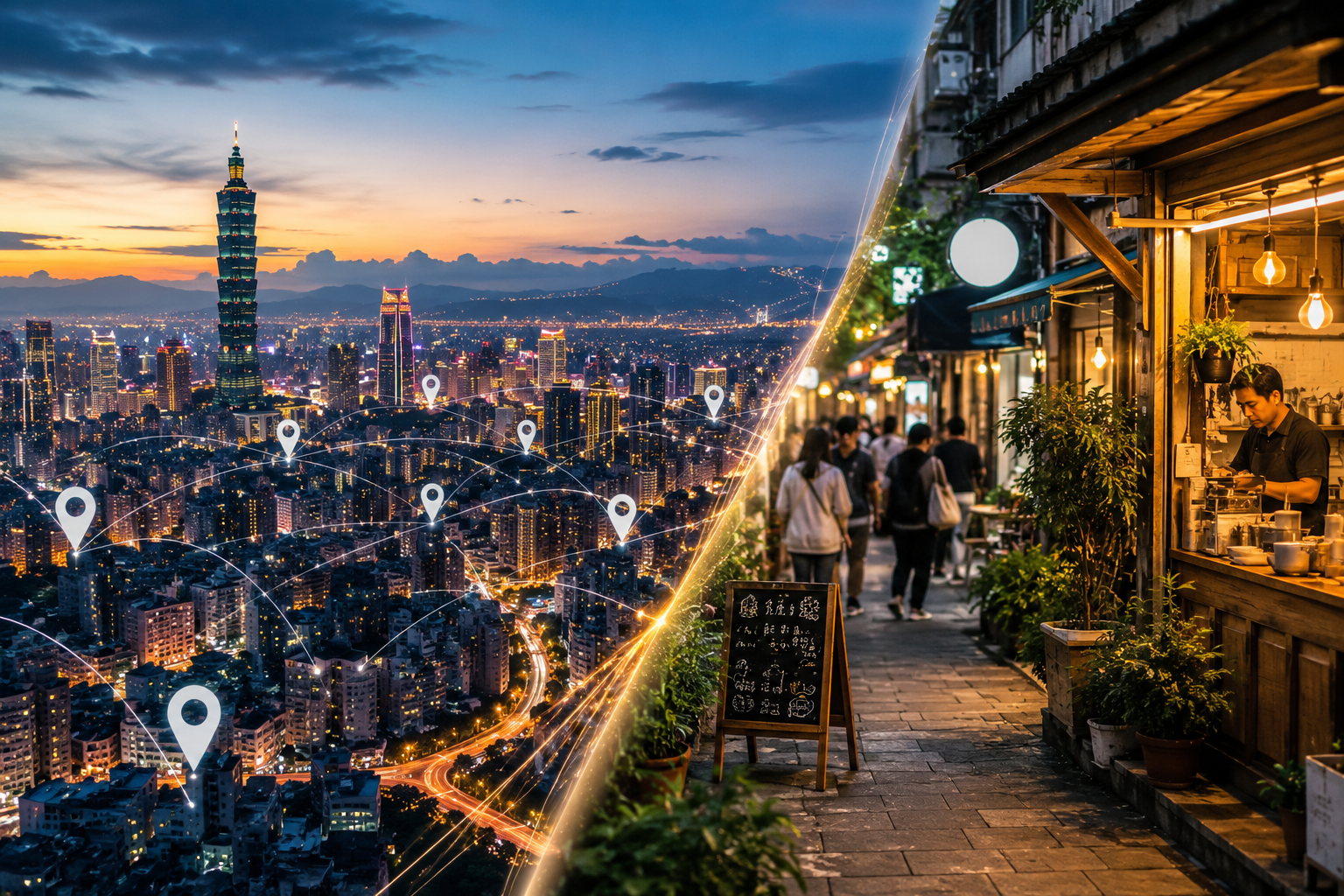
When people talk about the gig economy, the conversation usually revolves around logistics.
How do we deliver faster?
How do we reduce delivery costs?
How do we improve utilisation of riders and drivers?
These are important questions.
But after spending time studying Taiwan’s local commerce landscape, I believe they are no longer the most interesting questions.
The more important question is:
How does a great local merchant get discovered?
Taiwan Is an SME Economy
According to Taiwan’s SME Administration, Taiwan has more than 1.7 million SMEs.
These businesses account for:
- More than 98% of all enterprises
- Nearly 80% of employment
- More than half of Taiwan’s business revenue
This is one of the strongest SME ecosystems anywhere in Asia.
Walk through Taipei, Taichung, Tainan, or Kaohsiung and you will find an economy built around local businesses.
Tea shops.
Breakfast stores.
Independent cafés.
Family-owned restaurants.
Neighbourhood retailers.
Specialist service providers.
These businesses are not the exception.
They are the economy.
The First Decade Was About Convenience
The first wave of digital commerce solved a major problem.
Convenience.
Consumers no longer needed to search manually for merchants or call stores individually.
Platforms aggregated supply and demand into a single experience.
This created enormous value.
Consumers gained choice.
Merchants gained reach.
Platforms gained scale.
Everyone benefited.
The Next Decade Is About Discovery
As platforms mature, a different challenge emerges.
Attention becomes scarce.
Consumers increasingly see similar merchants, similar recommendations, and similar experiences.
Meanwhile, thousands of independent businesses compete for visibility.
This is where I believe the next opportunity lies.
Not in moving food from Point A to Point B faster.
But in helping consumers discover merchants they would otherwise never encounter.
The economics are important.
For many local merchants, customer acquisition is often a larger challenge than fulfilment.
A merchant can prepare the order.
A rider can deliver the order.
But neither matters if the customer never discovers the business in the first place.
Why This Matters
The strongest local commerce ecosystems create value for three participants simultaneously:
- Customers discover better options.
- Merchants gain sustainable demand.
- Service providers facilitate the interaction efficiently.
Historically, the focus has been on the third participant.
I believe the next phase of innovation will focus increasingly on the first two.
The Limits of the Super App
For much of the past decade, the dominant strategy in Asia was simple:
Build bigger ecosystems.
Add more services.
Increase engagement.
Become the destination.
The strategy worked.
However, technology is reducing the cost of distribution and customer engagement.
Consumers no longer need a single destination for everything.
Commerce can increasingly happen wherever consumers already spend time.
This shift creates new possibilities for merchants and consumers alike.
What I Believe Happens Next
I don’t believe Taiwan’s biggest local commerce opportunity is another race for faster delivery.
I believe it is helping local businesses become more discoverable.
The future winners will not simply move products efficiently.
They will help consumers find better merchants.
Taiwan is uniquely positioned for this shift because of its dense SME ecosystem, high digital adoption, and strong culture of neighbourhood commerce.
The next chapter of Taiwan’s gig economy may not be about logistics.
It may be about visibility.
And for millions of local businesses, that distinction matters.
Sources
Taiwan SME Administration (Ministry of Economic Affairs)
- SMEs: 1.7+ million
- 98%+ of enterprises
- Nearly 80% of employment
- More than 50% of business revenue
Industry market reports on Taiwan’s food delivery sector growth and local commerce trends.